

Project: The Invisible Value of Effort
Discipline: Product Design · UX Psychology · Interactive Storytelling
Experience: Immersive, scroll-driven digital narrative
Concept: Exploring how visible effort shapes perceived value, and how thoughtful UX can transform invisible processes into understandable experiences.
Inspiration: Growth.Design – Labor Perception Bias
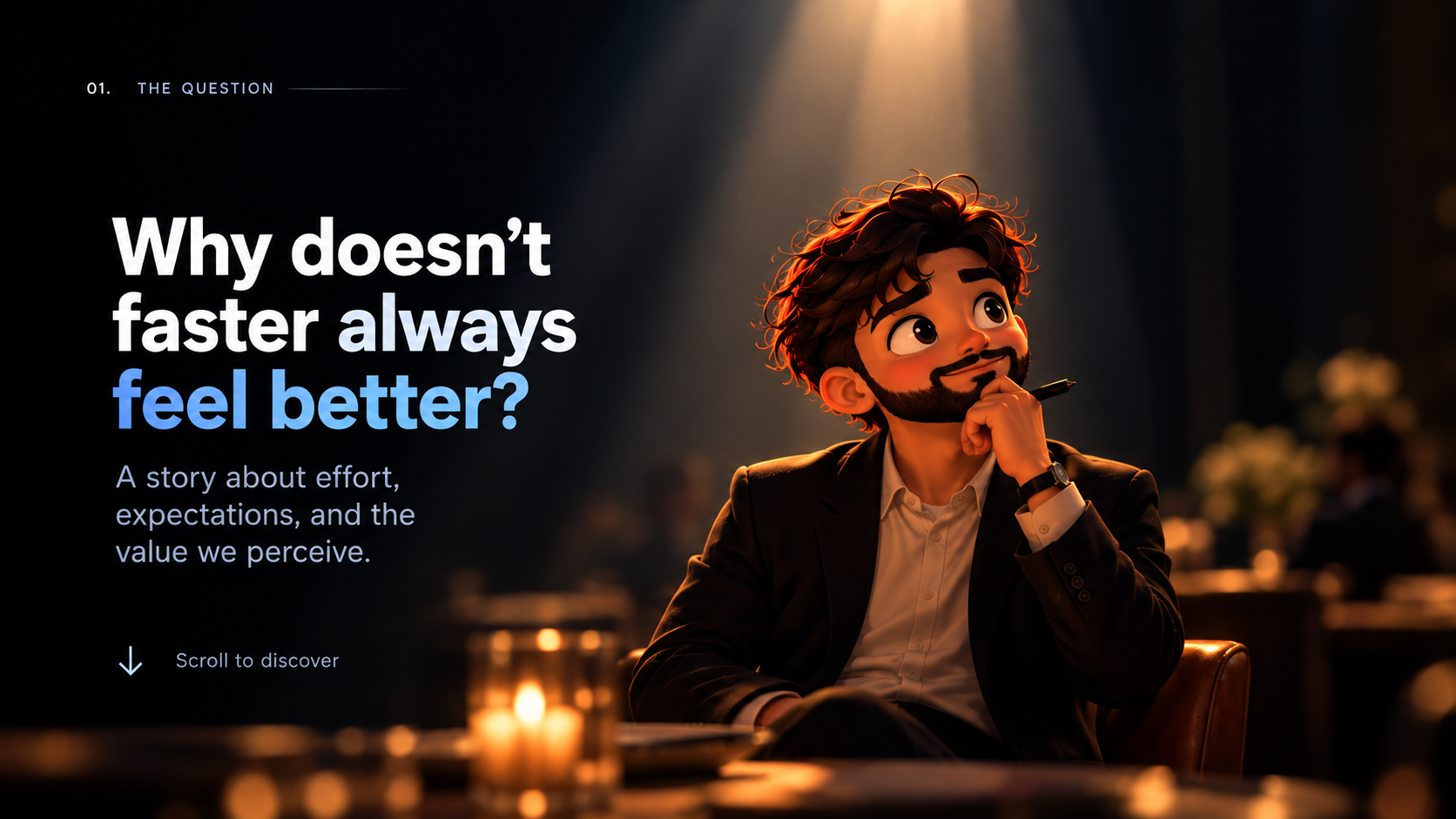
We live in a world obsessed with speed.
Faster deliveries. Faster services. Faster technology.
Every second saved is supposed to make our lives better.
And most of the time, it does.
But here’s a curious question.
What if making something faster sometimes makes it feel less valuable?
What if the result is exactly what you wanted…
But the experience still leaves you wondering whether something is missing?
To understand why, let’s start with a dinner.

It’s Friday evening.
After a long week, you’ve finally booked a table at a restaurant you’ve wanted to visit for months.
The lighting is warm. The music is soft. Every detail feels carefully considered.
You look around.
The polished glasses. The beautifully arranged tables. The attentive staff.
Everything communicates the same message:
You’re about to experience something special.
You sit down, adjust you jacket, and open the menu.
You notice the chef’s signature dish.
It’s expensive.
But that’s part of what makes it interesting.
You’re not simply paying for food.
You’re expecting creativity. Expertise. Attention to detail.
You’re expecting something that couldn’t have been prepared just anywhere.
The waiter approaches
WAITER: Good evening, sir. May I take your order?
You: Yes, I’ll have the chef’s signature dish.
WAITER: An excellent choice, sir.
The waiter closes the menu and walks away.
You settle into your chair.
You take a sip of water.
You glance around the restaurant.
And you wait for the experience to unfold.
But then…
Something unexpected happens.
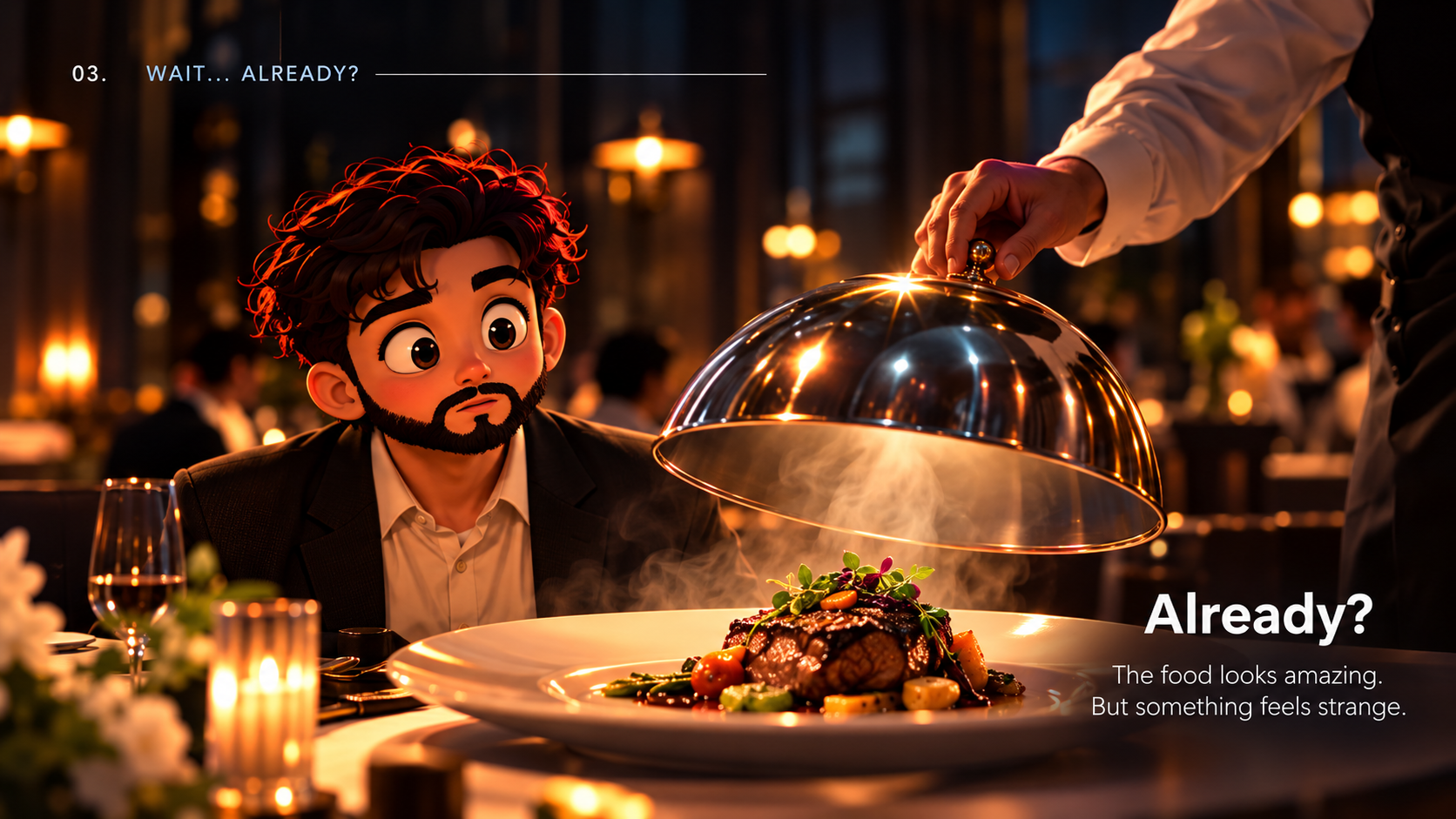
Before you’ve even had time to enjoy the atmosphere, the waiter returns.
He’s carrying your meal.
WAITER: Your signature dish, sir. Enjoy your evening.
The silver cover lifts.
There it is.
Beautifully arranged.
Perfectly presented.
Exactly what you ordered.
You: Wait… already?
That was fast.
Really fast.
And while the food looks incredible, a strange thought crosses your mind.
You: Did they just have this ready somewhere?
Maybe it was prepared earlier.
Maybe they simply reheated it.
Maybe there wasn’t much work involved after all.
You don’t actually know.
But suddenly, you’re questioning the experience.
Let’s consider what’s happened.
The restaurant hasn’t changed.
The chef hasn’t changed.
The food hasn’t changed.
You haven’t even tasted it yet.
So why does the experience suddenly feel less special?
Because part of what you expected to receive wasn’t just the meal itself.
It was the craftsmanship behind it.
The sense that someone had taken time to create something specifically for you.
But none of that work was visible.
And without seeing it, your mind begins filling in the gaps.
When effort is invisible, its value can become invisible too.
But what if we could see what really happened?
Suddenly, the atmosphere changes.
The dining room was quiet and elegant.
The kitchen is alive.
Chefs move with precision. Ingredients are being prepared. Pans sizzle. Plates are inspected before leaving the counter.
This is the part of the experience you never saw.
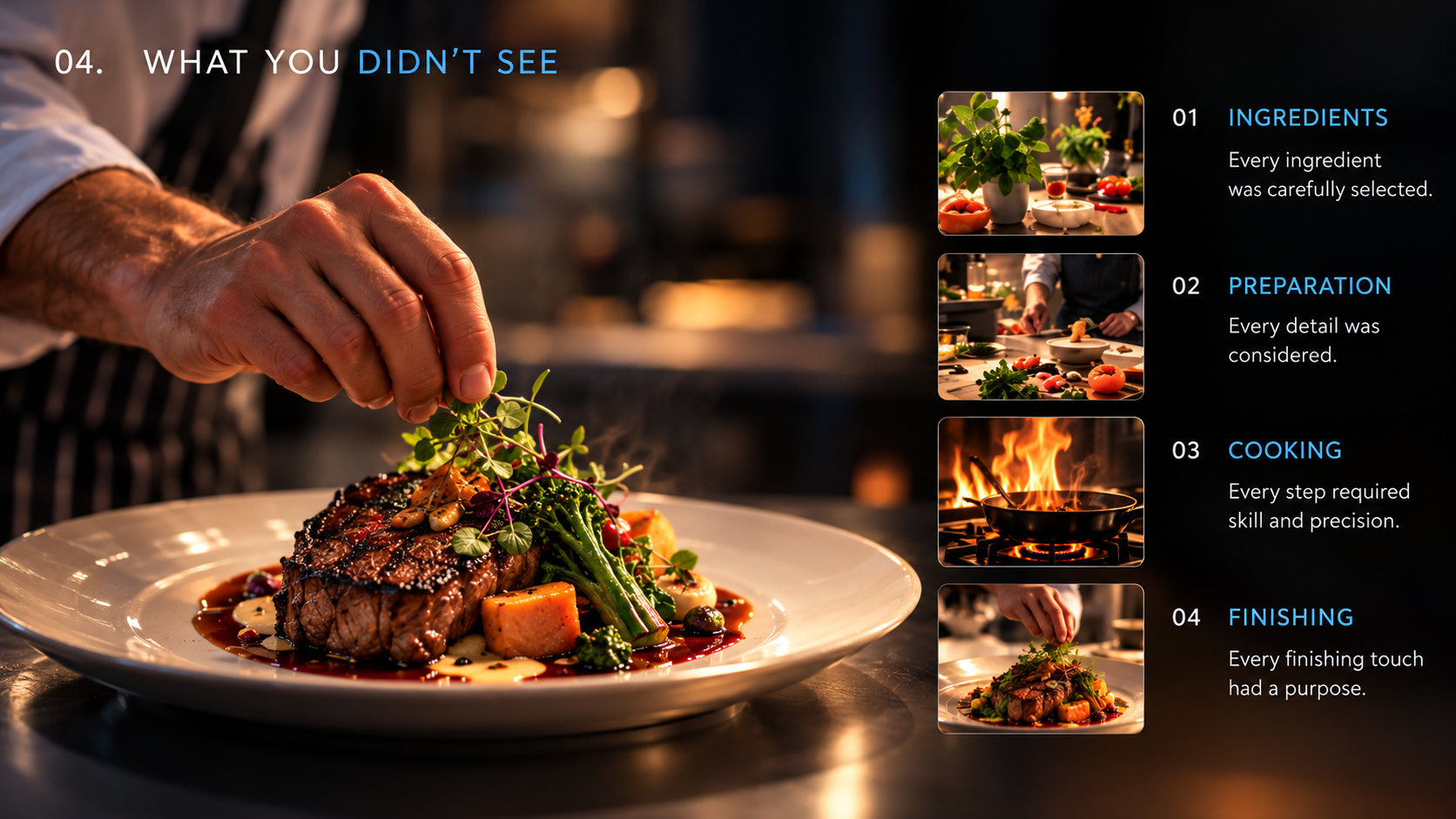
A chef examines the ingredients before preparing the dish.
Every component has been selected for a reason.
The freshness.
The texture.
The way different flavors
complement one another.
Great results begin long before they’re visible.
The camera moves closer.
A knife moves carefully through the ingredients.
Every cut is deliberate.
Every measurement matters.
What looks effortless from the dining room requires knowledge and practice behind the scenes.
Precision is rarely accidental.
The chef moves between the stove and the preparation counter.
Temperature, timing, and technique come together.
A few seconds too long could change the result.
A small adjustment could make it better.
Expertise is often hidden inside decisions we never notice.
The chef begins arranging the finished meal.
One ingredient is repositioned.
A final garnish is added.
The plate is examined from every angle.
Only when everything is ready does the chef allow it to leave the kitchen.
The result is the product of dozens of deliberate decisions.
The finished dish moves through the kitchen doors.
The waiter picks it up.
And suddenly…
We’re back at the exact moment when the food arrived.
The same plate. The same table. The same protagonist.
Nothing about the result has changed.
The dish is identical.
The presentation is identical.
Even the time it took to reach the table is identical.
But now you know something you didn’t know before.
You know about the ingredients.
The preparation.
The precision.
The attention to detail.
You understand that the speed of the service didn’t mean the absence of effort.
The work was always there.
Only your awareness of it changed.
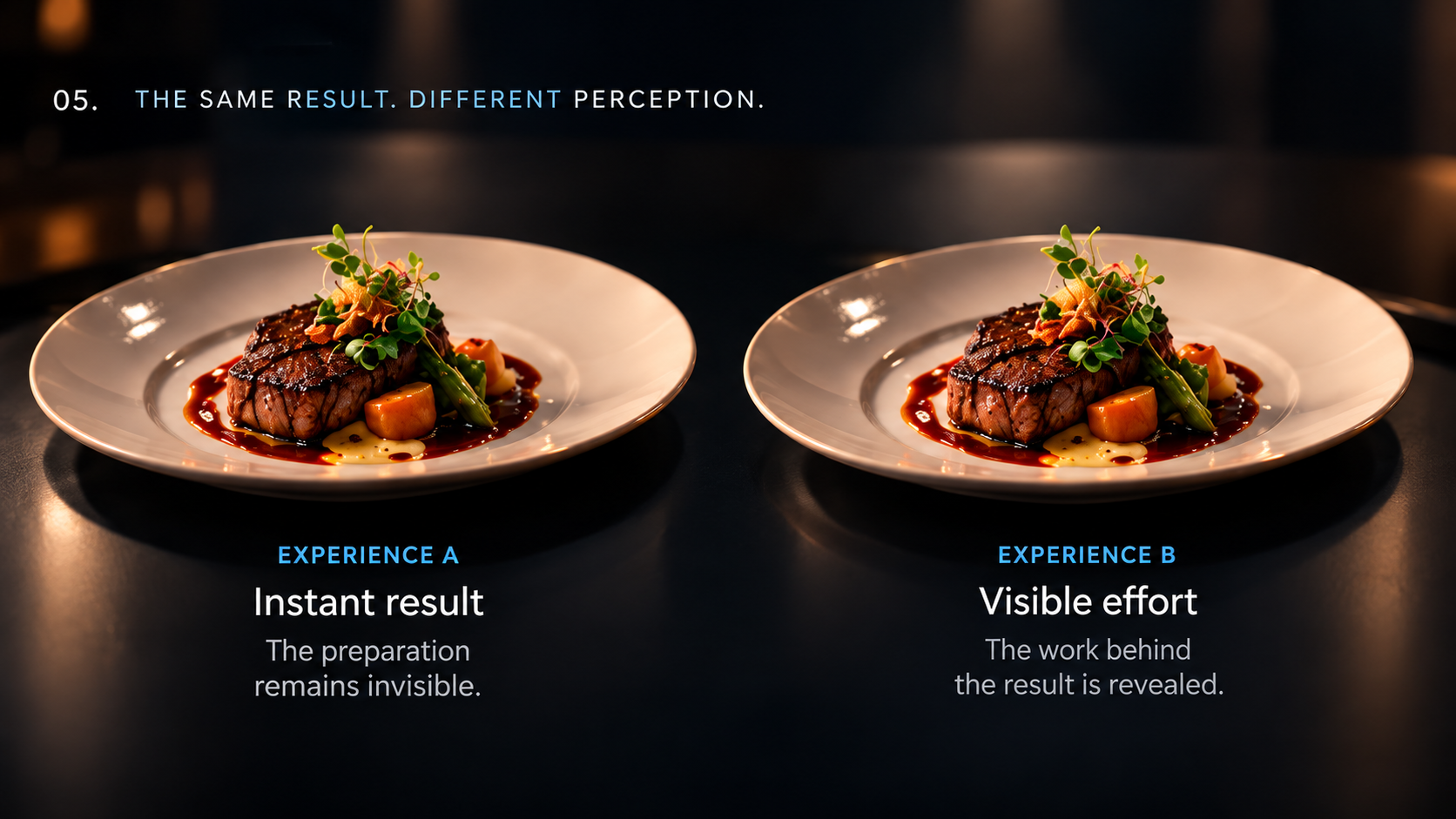
One plate appears in the center of a black studio.
Then another.
They are completely identical.
Same ingredients.
Same quality.
Same presentation.
Same outcome.
But imagine two different experiences.
EXPERIENCE A
You receive the meal immediately, with no indication of the work behind it.
You see the result.
Nothing more.
EXPERIENCE B
You receive the same meal, but you’ve also seen the careful preparation behind it.
You understand the work involved.
You recognize the expertise.
The result is identical.
The story surrounding it is different.
And that story can influence how valuable the result feels.
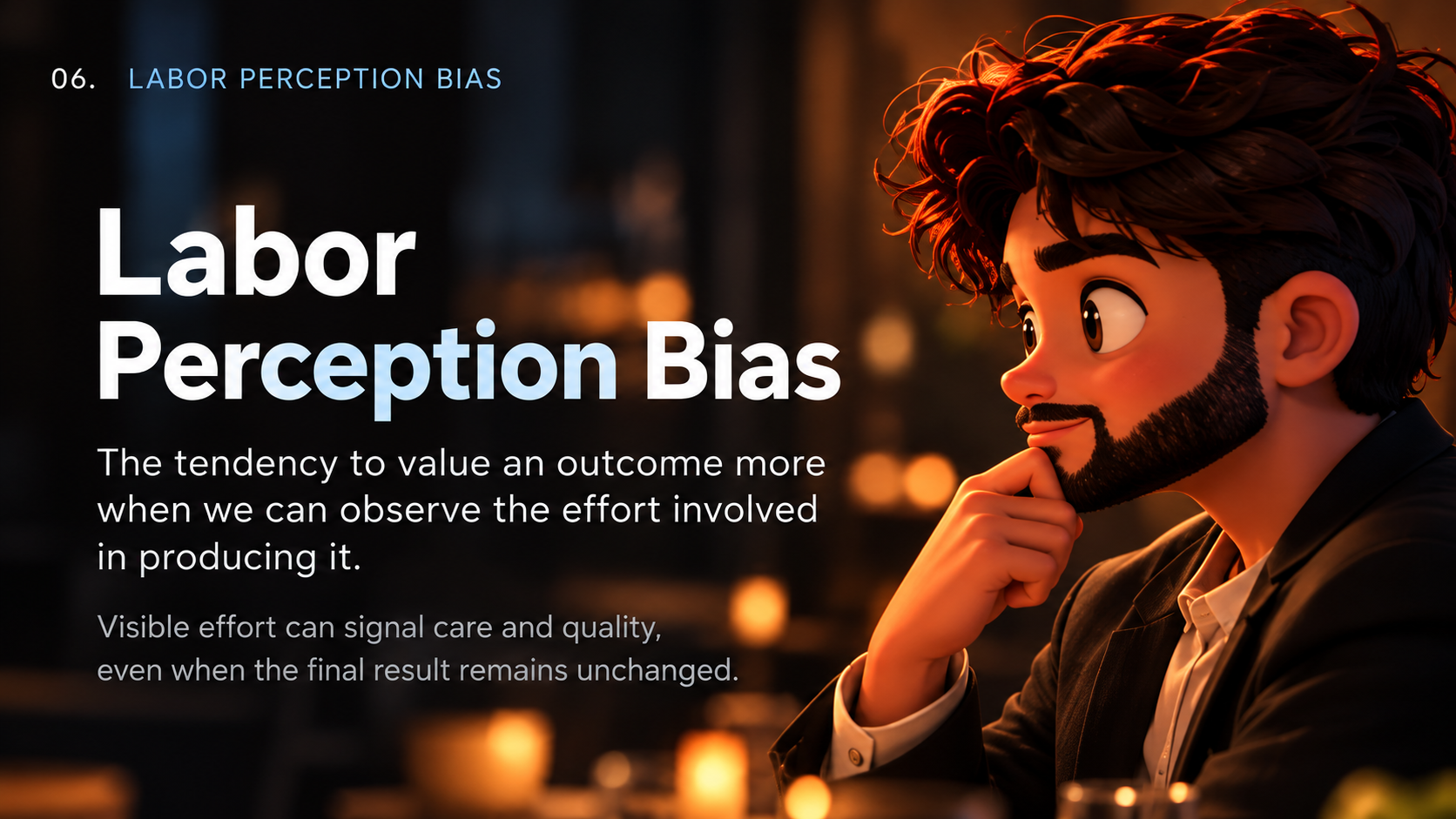
We don’t always judge value by the outcome alone.
Sometimes, we also judge it by the effort we believe produced that outcome.
When we see someone carefully preparing a meal, solving a difficult problem, or creating something with precision, we gain additional information about the process.
That information can influence our perception.
We may associate visible effort with greater care.
Greater expertise.
Greater dedication.
And ultimately, greater value.
This phenomenon is commonly described as:
The tendency for perceived effort to influence how much we value an outcome.
It doesn’t mean that more effort always produces a better result.
And it doesn’t mean that slower is always better.
It means that when meaningful work becomes visible, people may appreciate an outcome differently.
The important distinction isn’t how much work exists.
It’s how much of that work we understand.
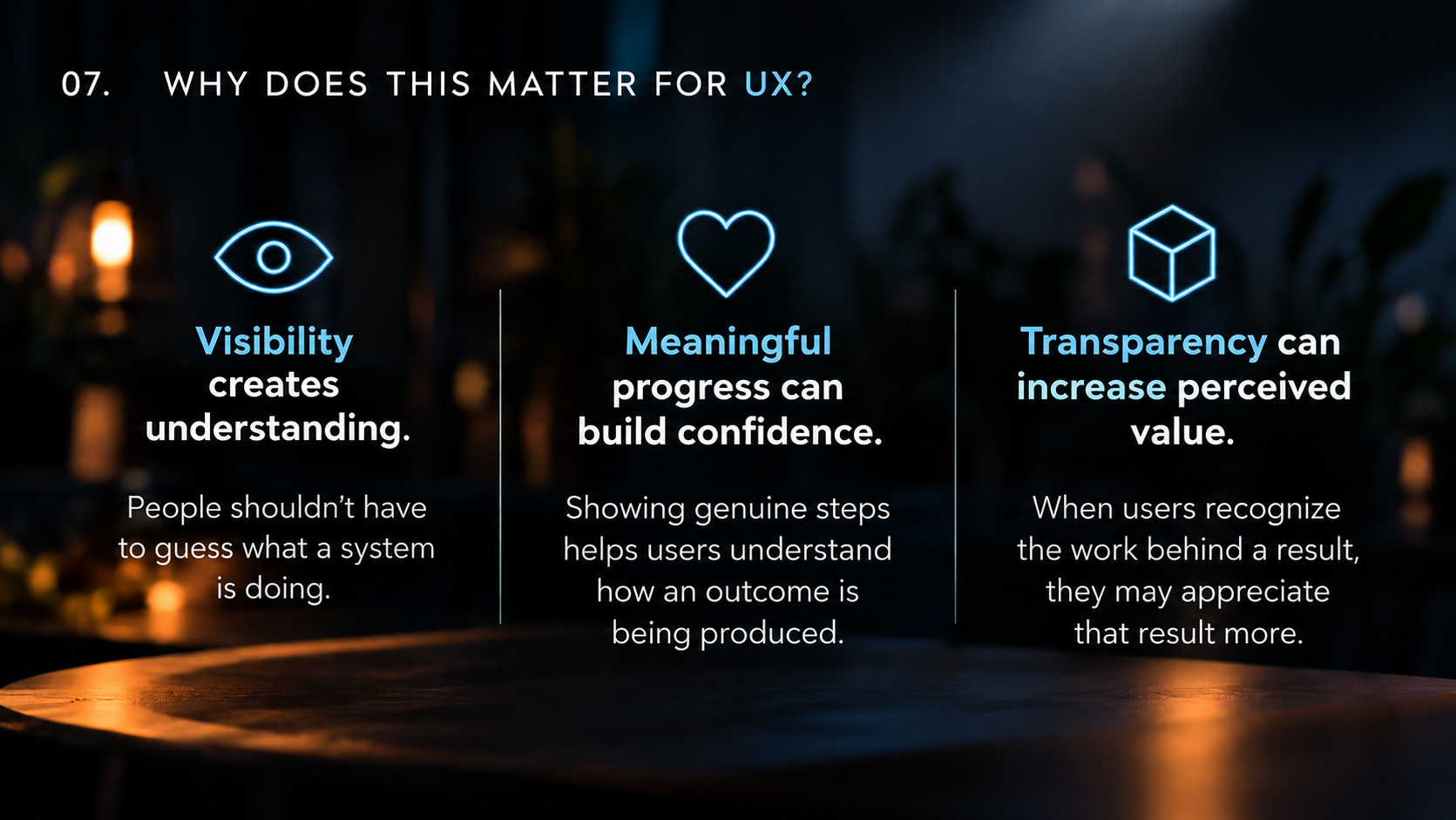
Think about how many things happen around us without being seen.
A restaurant prepares your meal.
A mechanic diagnoses your car.
A designer explores dozens of solutions before choosing one.
A software system processes thousands of records in seconds.
In each case, the final result is only a small visible part of a much larger process.
We experience the outcome.
But we rarely experience the work behind it.
And when that work is invisible, it’s easy to underestimate its complexity.
Now consider what happens when the same problem appears inside a digital product.
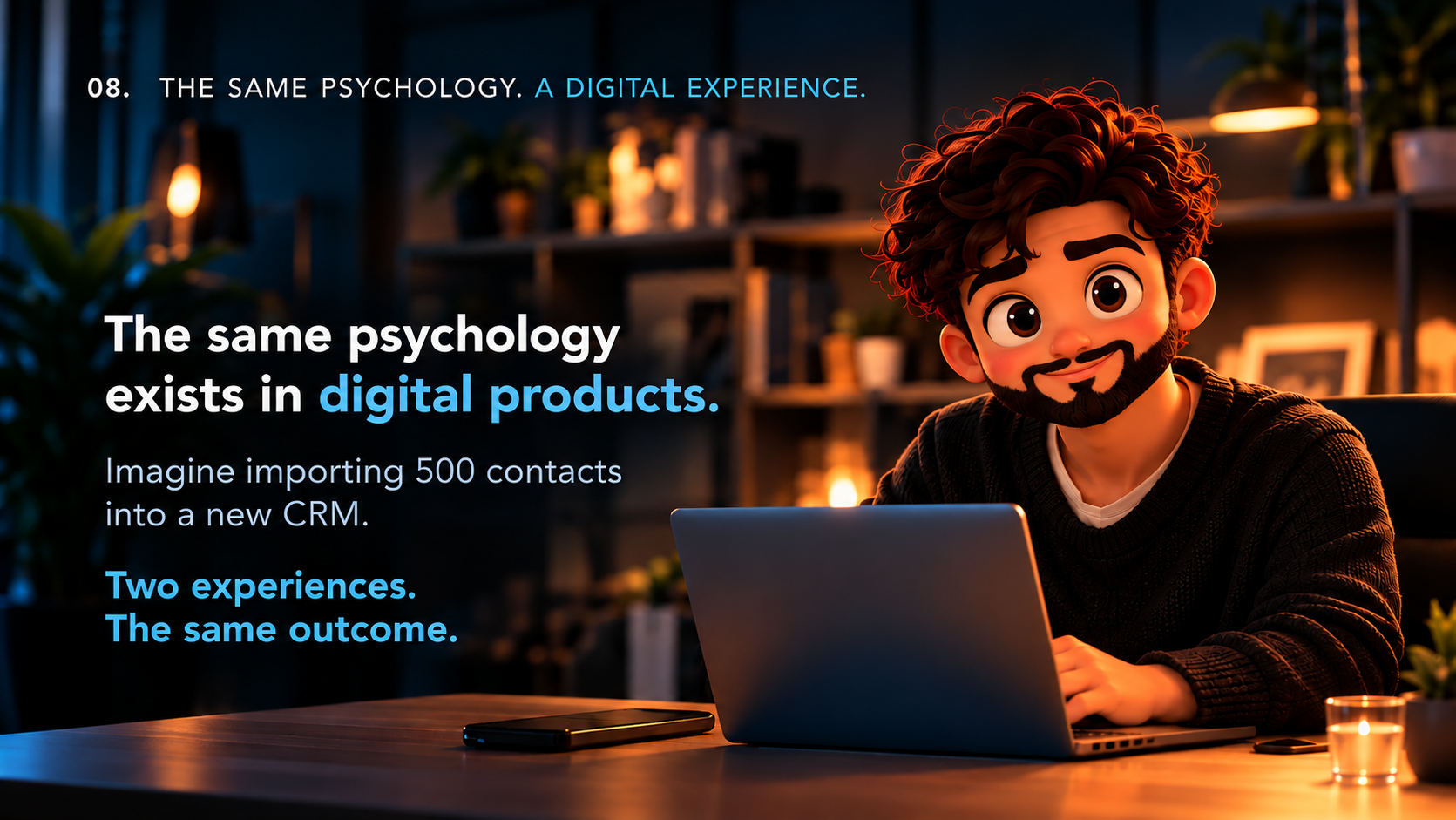
You are now sitting at a computer.
You are setting up a new customer relationship management platform.
You have a spreadsheet containing 500 contacts.
Names.
Email addresses.
Phone numbers.
Company information.
You want to import everything into the new system.
A simple task.
At least, that’s how it appears.
Upload a file. Click a button. Wait for the result.
You select a file and click Import.
But behind that button, the system may need to perform several operations.
It needs to read the file.
Check the information.
Identify duplicates.
Organize the records.
Save the contacts.
And report whether the import succeeded.
A single click can hide an entire sequence of work.
So how should the interface communicate that process?
Let’s compare two experiences.
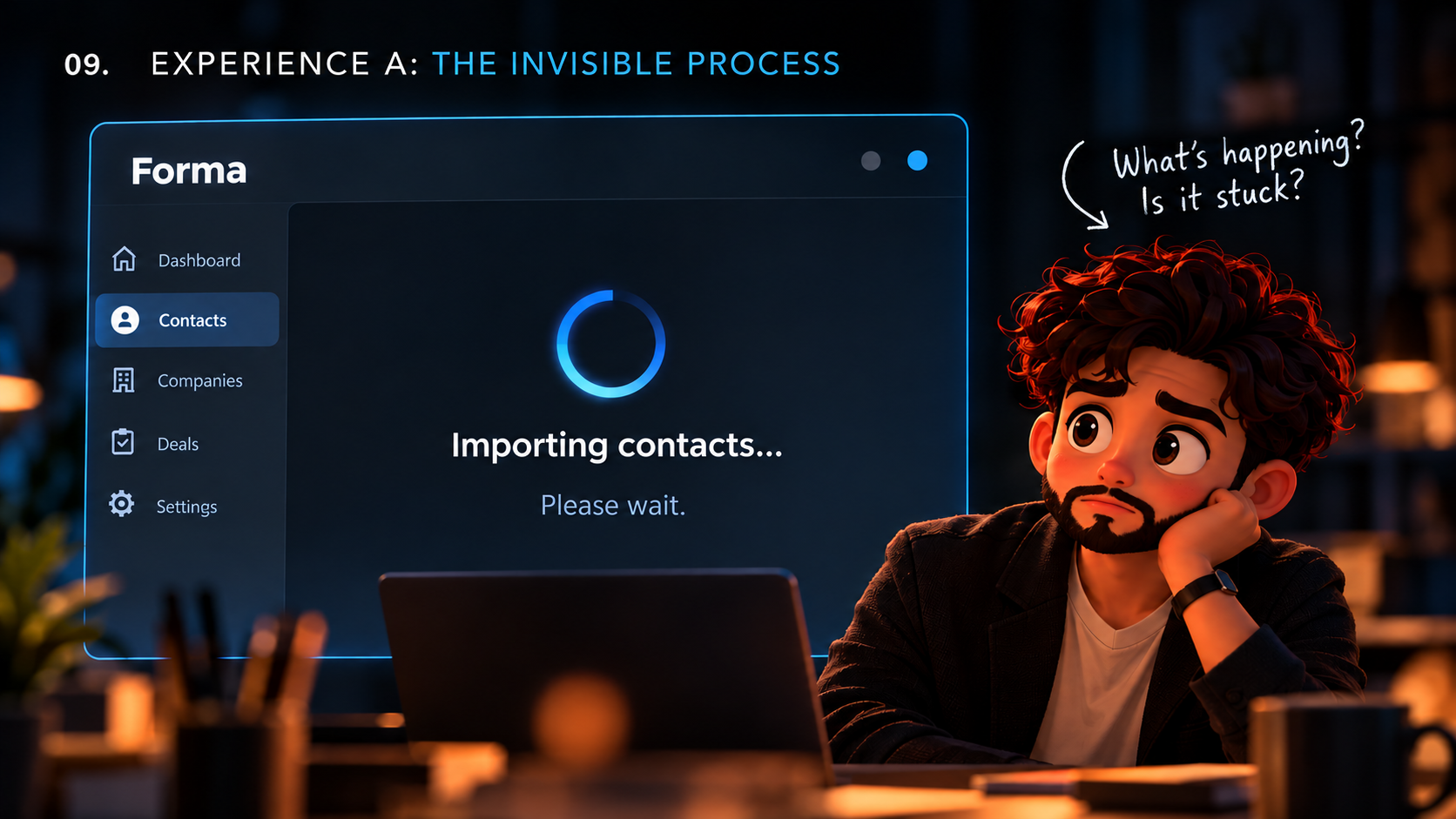
You click:
Import 500 contacts
A loading indicator appears.
Importing contacts…
Please wait.
The indicator keeps spinning.
There is no explanation.
No indication of progress.
No information about what the system is doing.
You: Is it working?
You wait.
You: Did something go wrong?
A few moments later, the loading indicator disappears.
A success message appears.
Import complete.
500 contacts successfully imported.
The task is finished.
Everything worked.
But the experience left the user uncertain.
The system did its job.
It just didn’t communicate the work.
The same interface returns.
The same file.
The same 500 contacts.
The same underlying task.
The protagonist clicks Import again.
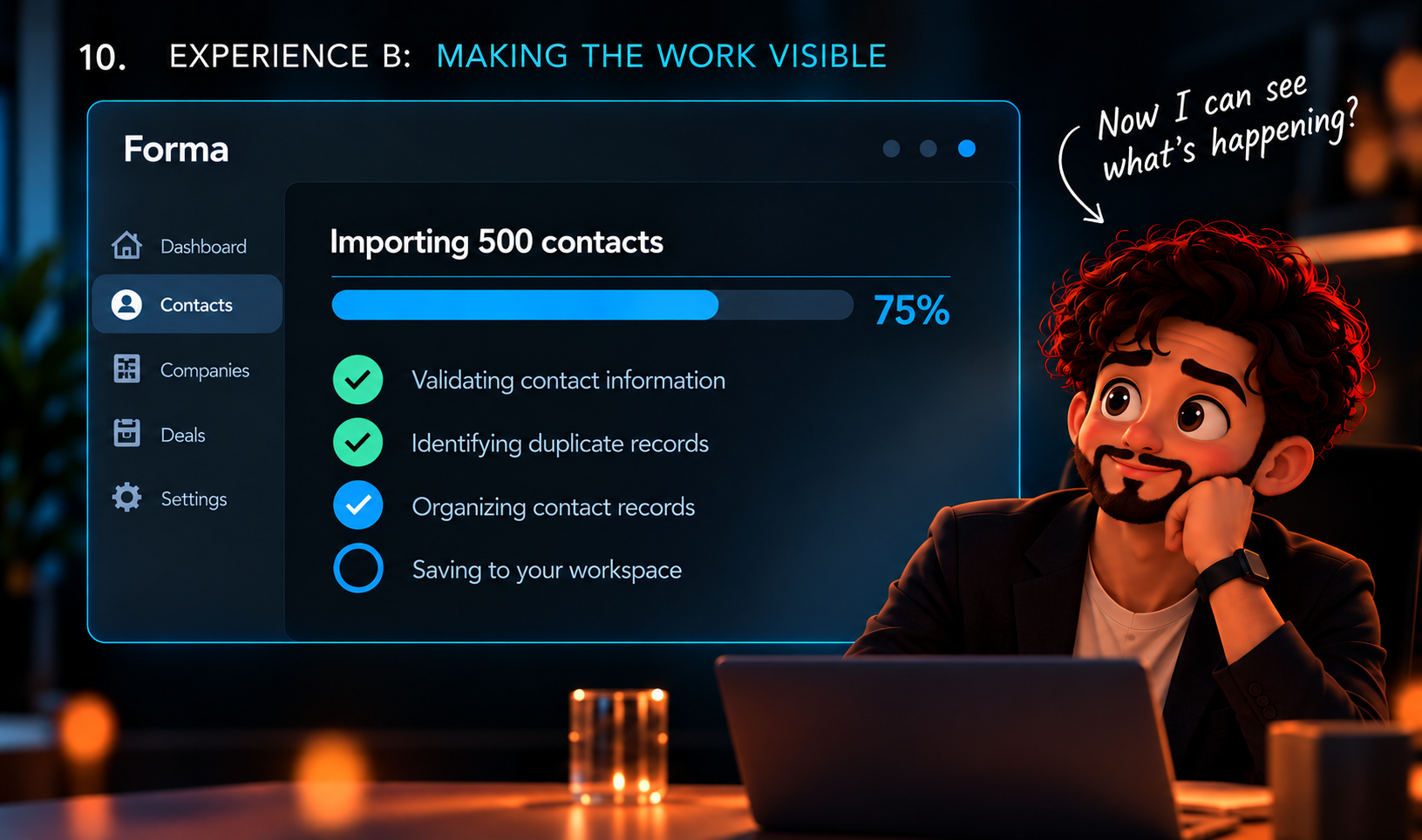
But this time, the interface communicates what’s happening.
Importing 500 contacts
Checking contact information
The system validates the required fields.
A checkmark appears.
Identifying duplicates
The system checks for existing records.
Another checkmark appears.
Organizing your contacts
The records are prepared and saved.
The progress indicator advances as the work is completed.
You: Oh, it’s checking everything before importing.
He understands why the operation is taking time.
He knows what the system has already completed.
And he has a clearer idea of what remains.
Finally:
Import complete.
500 contacts successfully imported.
The result is exactly the same.
But the experience has changed.
The user isn’t simply waiting anymore.
They’re informed about the work taking place.
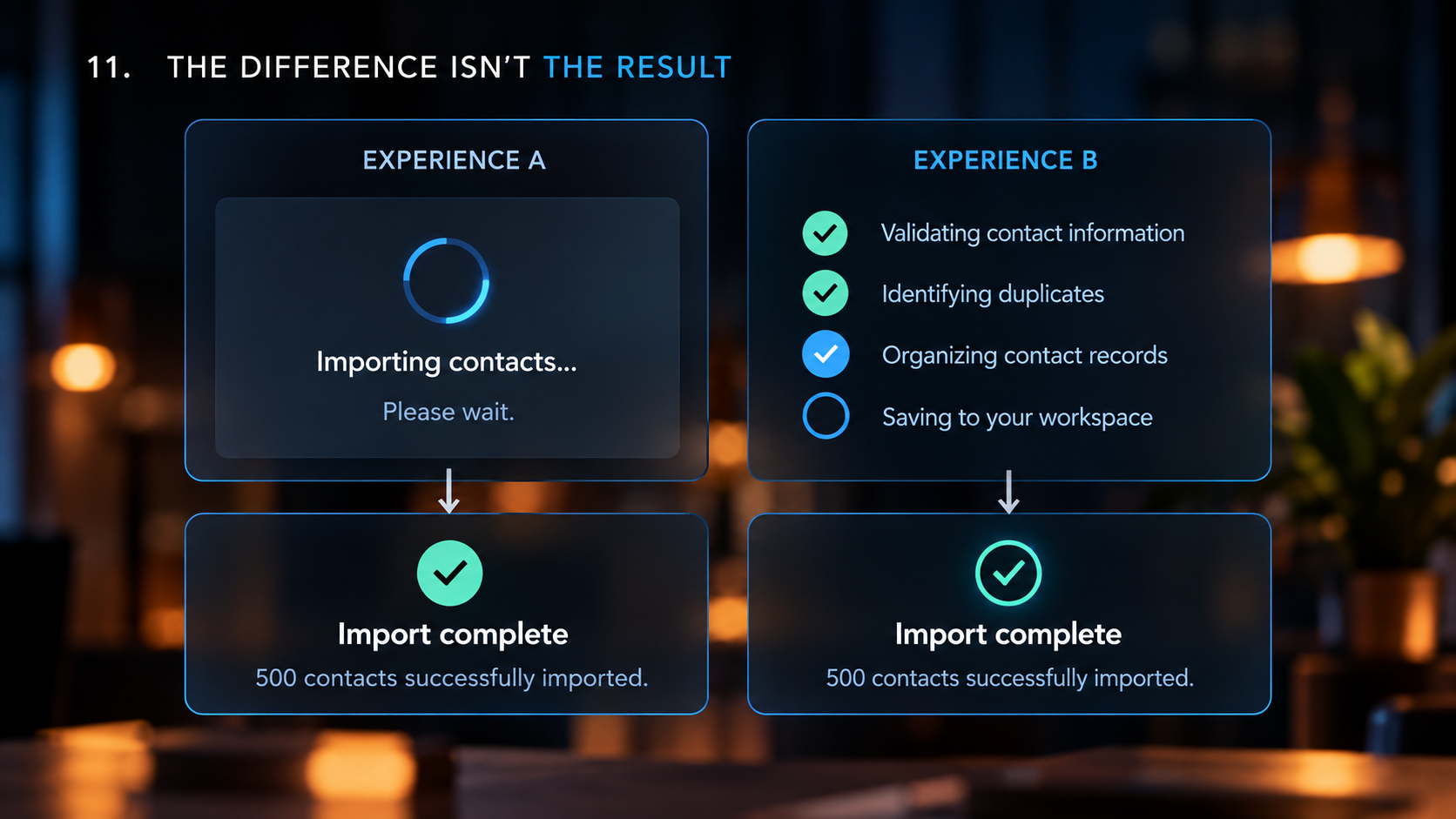
On the left:
EXPERIENCE A
A generic loading indicator.
On the right:
EXPERIENCE B
Meaningful progress feedback.
Both systems complete the same operation.
Both import the same 500 contacts.
Neither is inherently more capable than the other.
The difference lies in how the process is communicated.
Experience A hides the work.
The user has little information and must wait without context.
Experience B reveals meaningful work.
The user can follow the process and understand what is happening.
The second experience doesn’t need to perform more work.
It simply communicates the existing work more effectively.
And sometimes, understanding a process can make the experience feel more trustworthy and valuable.
If visible effort can increase perceived value…
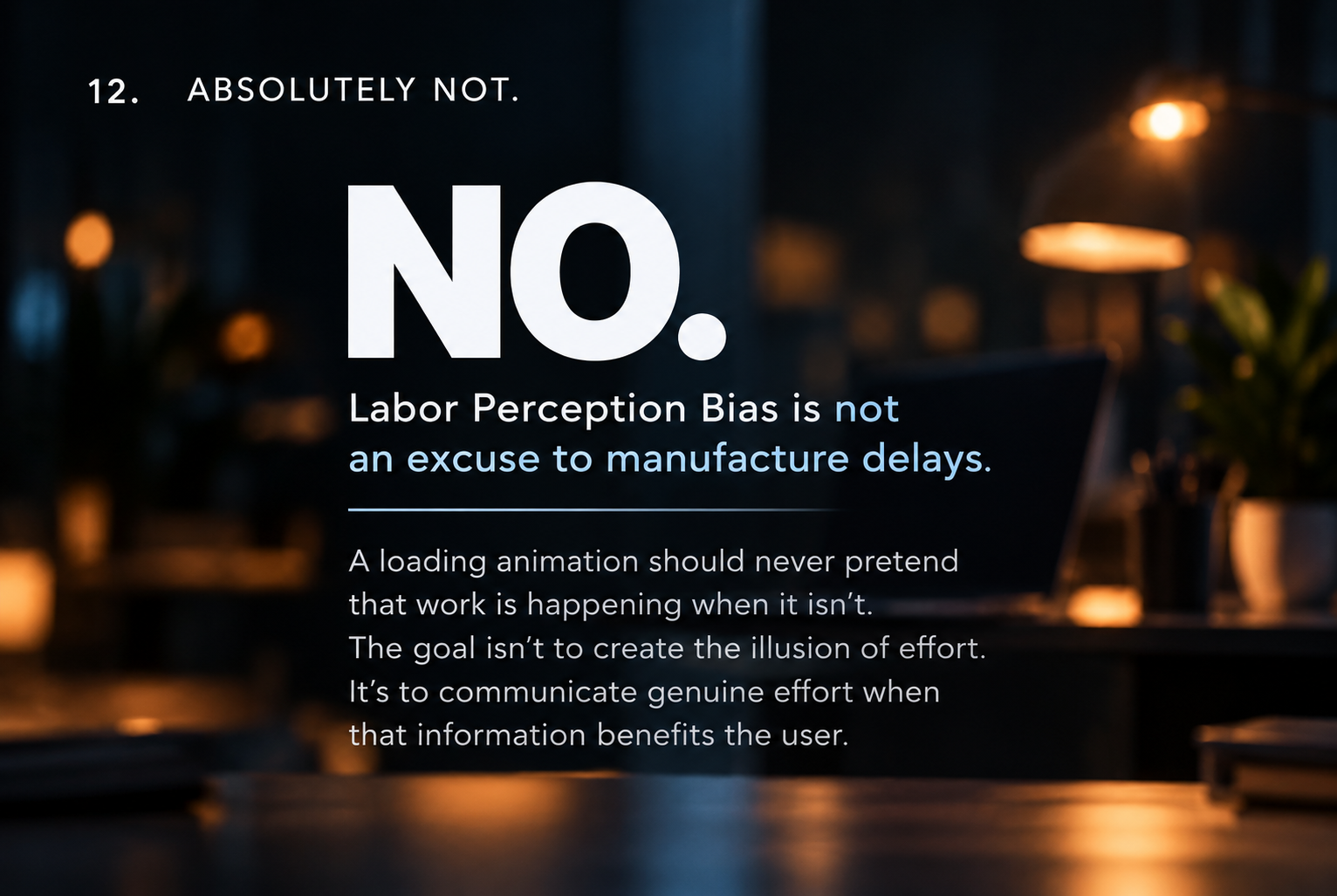
Should we deliberately make digital products slower?
A pause.
Then one word fills the screen.
Speed is still valuable.
Efficiency is still valuable.
And users should never be forced to wait just so a product can appear more sophisticated.
Imagine intentionally delaying a payment confirmation.
Or making a search take longer than necessary.
Or showing fake processing steps for work that has already finished.
That wouldn’t create meaningful value.
It would create friction.
Labor Perception Bias isn’t a reason to manufacture effort.
It’s a reason to communicate genuine effort when doing so helps the user.
Not every interaction needs an explanation.
If a button responds instantly, let it respond instantly.
If a search completes immediately, show the results.
If a task takes longer and involves meaningful operations, consider whether users would benefit from knowing what’s happening.
The goal isn’t to make every process visible.
It’s to make the right information visible at the right moment.
A useful progress experience should answer three questions.
What’s happening?
Give users a clear understanding of the current operation.
Why is it taking time?
Provide context when the process is complex or unfamiliar.
What happens next?
Help users understand what remains and what to expect.
When these questions are answered clearly, progress feedback becomes more than an animation.
It becomes part of the experience.
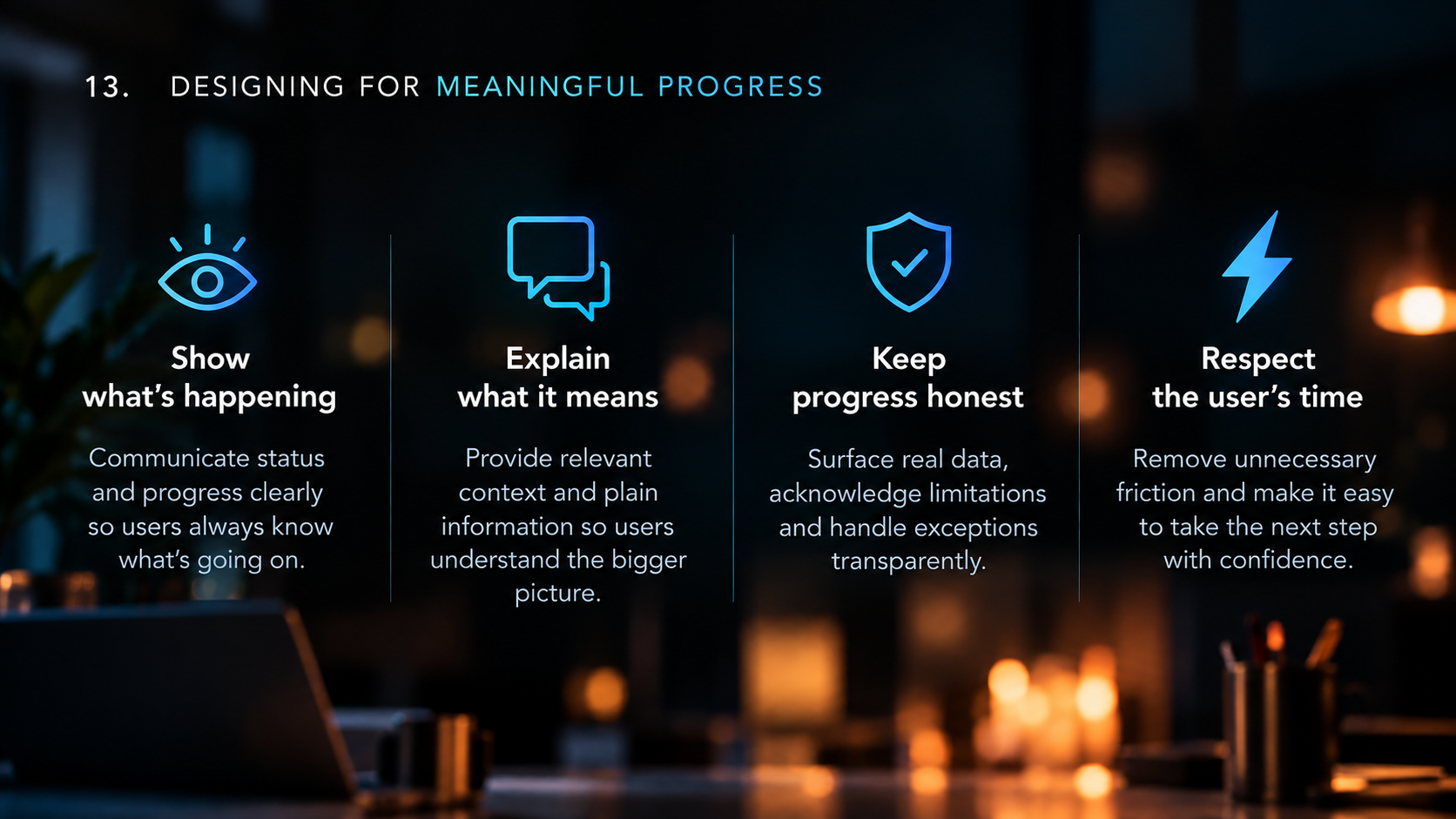
Show relevant operations when they help users understand what’s happening.
Use genuine system states and accurate information. Avoid fabricated percentages and misleading steps.
Explain delays, acknowledge problems, and give users a clear sense of what to expect.
Never introduce unnecessary waiting to make a process appear more valuable.
Good design doesn’t need to exaggerate effort.
It needs to make complexity understandable.
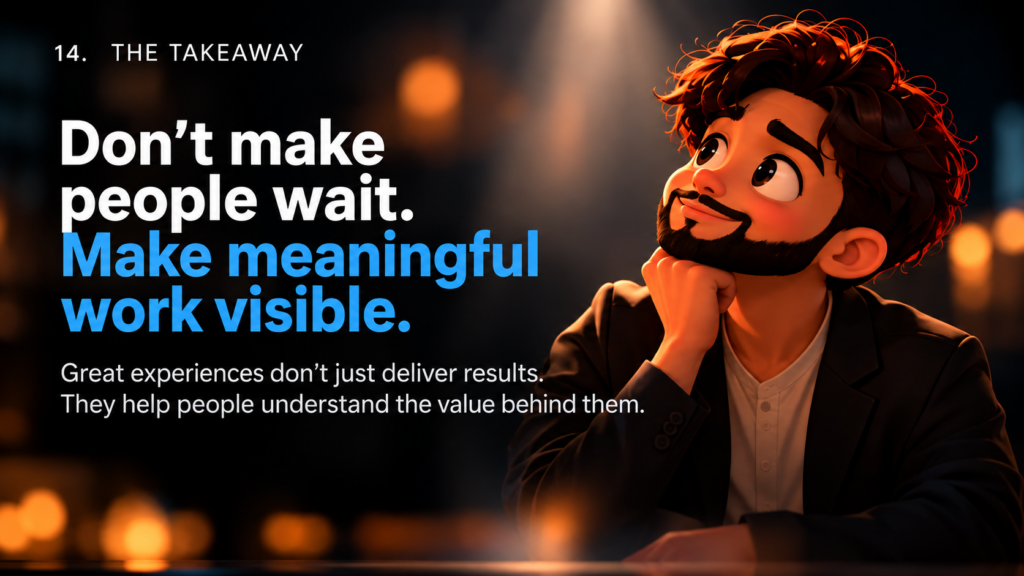
You are sitting at the same table.
The same dish is in front of you.
The waiter stands nearby.
But this time, you look at the meal differently.
You know what happened in the kitchen.
You understand the preparation.
You recognize the care behind the result.
You: Now that makes sense.
You smile.
Then slowly pull away.
The meal didn’t change.
Your understanding did.
We often see the result.
But not the work behind it.
And sometimes, that invisible work is an important part of how we understand quality, care, and value.
In digital products, thoughtful feedback can help bridge that gap.
Not by making processes slower.
Not by creating artificial complexity.
But by revealing what genuinely matters.
One final statement remains.
Because great experiences don’t just deliver results.
They help us understand the value behind them.